
Vehicle modifications NZ Auckland regulations are governed primarily by the Low Volume Vehicle Technical Association (LVVTA) and NZ Transport Agency (Waka Kotahi). While minor replacements may pass a standard Warrant of Fitness (WOF), significant alterations to suspension geometry, engine power, or structural integrity require a Low Volume Vehicle (LVV) certification plate to be legally driven on New Zealand roads.
For car enthusiasts in Auckland, the desire to personalize a vehicle is often matched only by the confusion surrounding the legalities of doing so. Whether you are building a drift car, a 4×4 overlander, or simply want to lower your daily driver, understanding the regulatory landscape is critical. Failing to adhere to these rules can result in failed Warrants of Fitness (WOF), insurance voidance, and the dreaded “pink sticker” (green sticker for defect orders) from the police.
This comprehensive guide explores the specific legal requirements for vehicle modifications in New Zealand, with a focus on what Auckland drivers need to know to keep their pride and joy road-legal.
Understanding the Basics: WOF vs. LVV Certification
Before diving into specific parts, it is essential to understand the two tiers of vehicle inspection in New Zealand: the standard Warrant of Fitness (WOF) and the Low Volume Vehicle (LVV) certification.
The Warrant of Fitness Threshold
A WOF inspector applies the Vehicle Inspection Requirements Manual (VIRM). They are checking if the vehicle meets the manufacturer’s original safety standards. Generally, you can modify a vehicle without extra certification if the modification:
- Is a direct replacement using Original Equipment Manufacturer (OEM) parts.
- Does not affect the vehicle’s safety, structural integrity, or handling characteristics.
- Is considered a minor accessory (e.g., roof racks, certain cosmetic trims).
When Do You Need an LVV Cert?
The moment a modification moves outside the manufacturer’s specifications—changing the way the vehicle handles, stops, or performs—you enter the domain of the Low Volume Vehicle Technical Association (LVVTA). An LVV certifier is a specialized engineer authorized to inspect modified vehicles. If your car passes, you receive an aluminium LVV certification plate (usually riveted to the firewall or strut tower) listing the modifications.
Common triggers for LVV certification include:
- Adjustable suspension (coilovers).
- Engine swaps increasing power by more than 20%.
- Fitting bucket seats or altering seatbelt anchorages.
- Significant brake upgrades.
- Changing the gearbox or differential to a different type.
Suspension Modifications: Lowering, Lifting, and Handling
Suspension changes are the most common modification seen on Auckland roads. However, they are also the most frequent cause of WOF failures due to incorrect installation or illegal methods.
Lowering Your Vehicle
In New Zealand, you must maintain a minimum ground clearance of 100mm. This applies to any part of the vehicle structure, not just the body kit. If your exhaust or chassis rail scrapes a standard speed bump, it is likely illegal.
Springs: You can install lowering springs without certification provided they:
- Are designed for that specific vehicle.
- Remain “captive” (do not become loose) when the car is jacked up.
- Do not lower the vehicle below the 100mm threshold.
IMPORTANT: Cutting springs or heating springs to lower a car is strictly illegal and dangerous. This compromises the metal’s integrity and will result in an immediate fail and likely an unsafe vehicle order.
Adjustable Suspension (Coilovers)
Height-adjustable suspension (coilovers) almost always requires LVV certification. Even if you set them to a standard height, the mere fact that they can be adjusted classifies them as a modification requiring oversight. The certifier checks that the suspension has adequate travel (bump and droop) and does not contact the bodywork or tyres throughout its range of motion.
Engine Swaps and Performance Upgrades
Auckland has a vibrant culture of engine swaps, from putting Honda K-series engines into Minis to LS swaps in sedans. The rules here are based on power increases and structural modifications.
Same Engine Replacements
If you replace a blown engine with the exact same make and model of engine, no certification is required. This is considered a maintenance repair.
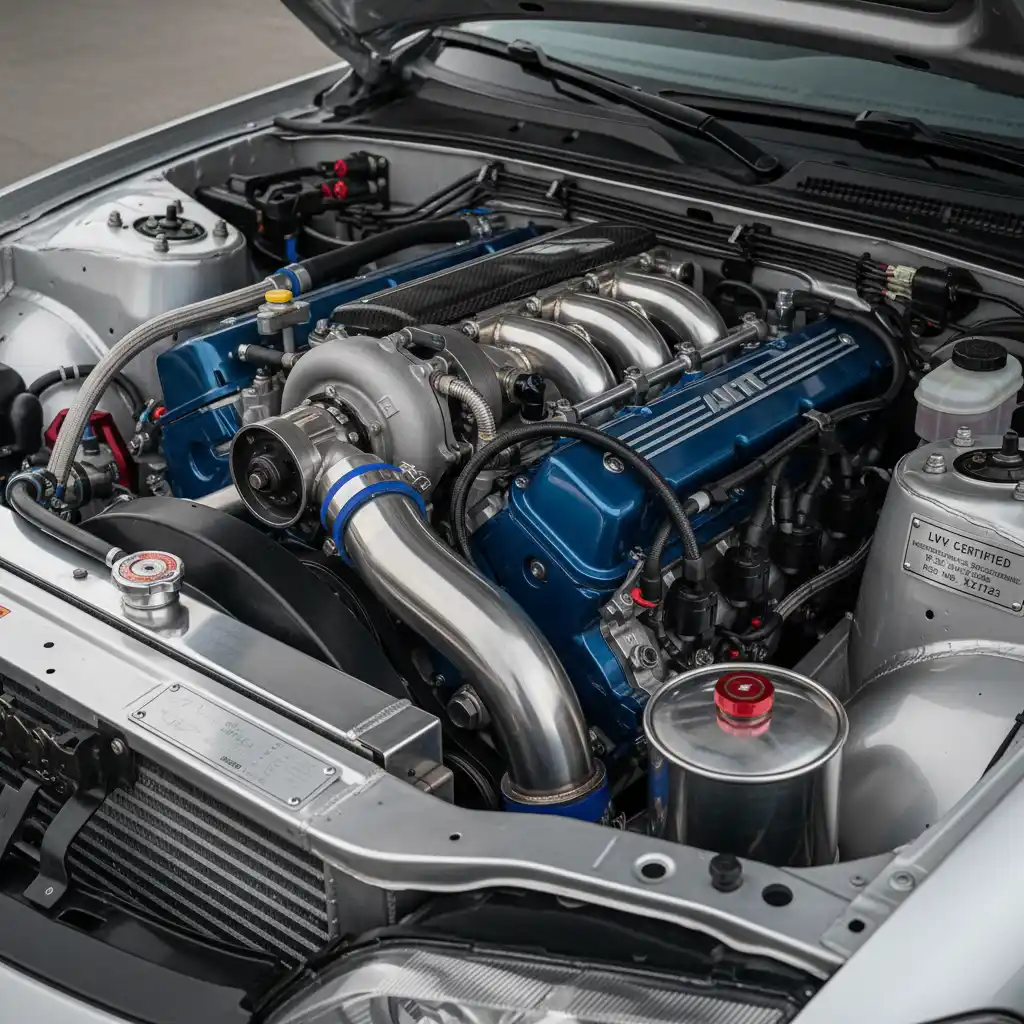
Power Increases and Turbos
According to NZTA regulations, if you increase the engine’s power output by more than 20% over the original specification, certification is required. This includes:
- Fitting a turbocharger or supercharger to a naturally aspirated engine.
- Upgrading a turbo to a significantly larger unit.
- Engine swaps from a different manufacturer or a higher-performance model.
When increasing power significantly, the certifier will also look at the rest of the drivetrain. Can the brakes handle the extra speed? is the driveshaft loop required? For high-power vehicles, a driveshaft safety loop is often mandatory to prevent the shaft from digging into the road if a universal joint fails.
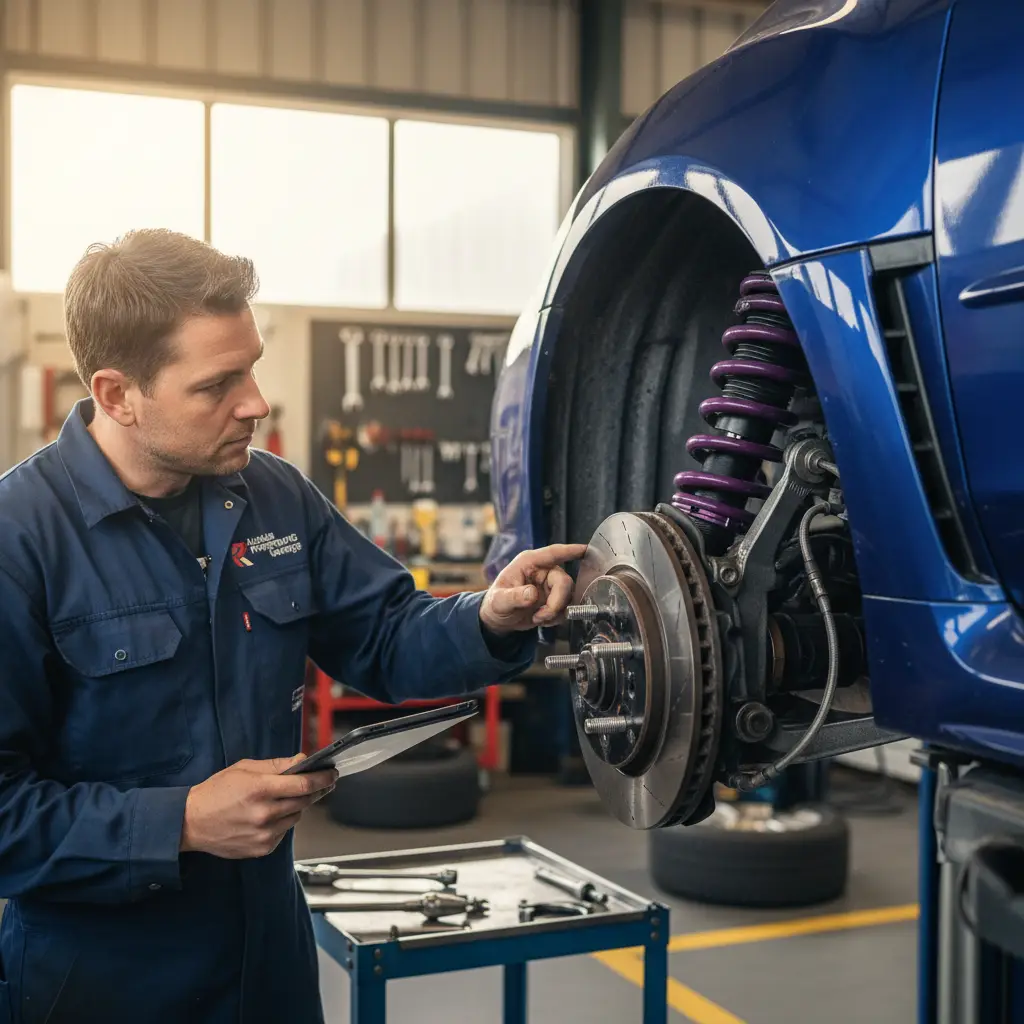
Brake Upgrades and Safety Requirements
Stopping power is arguably more important than horsepower. Modifications to braking systems are scrutinized heavily.
Discs and Calipers
Upgrading to larger discs or multi-pot calipers (e.g., upgrading a Subaru WRX to STI Brembos) generally requires certification. The certifier must ensure the master cylinder moves enough fluid to operate the larger calipers effectively and that the brake bias (front-to-rear balance) remains safe. If the bias is off, the rear wheels might lock up before the fronts, causing the vehicle to spin.
Braided Brake Lines
Stainless steel braided brake lines are a popular upgrade for better pedal feel. In New Zealand, these lines must meet specific international standards (such as FMVSS 106 or SAE J1401). If you purchase high-quality, branded lines, they usually comply. Cheap, unbranded lines from overseas marketplaces often lack the required markings and will fail a WOF.
Lighting, Exhausts, and Noise Regulations
Lighting and noise are the two aspects most likely to attract police attention in Auckland.
Exhaust Noise Limits
New Zealand has strict objective noise limits for light vehicles. The maximum noise output is generally:
- 95 decibels (dBA) for vehicles manufactured from 2008 onwards (and all rotary engines).
- 90 decibels (dBA) for vehicles manufactured before 2008.
While a WOF inspector makes a subjective assessment (if it sounds “significantly louder” than standard), a police officer can order an objective noise test. Removing catalytic converters is technically illegal if the vehicle was originally fitted with one, as it modifies the emissions control system, though enforcement varies. However, the exhaust must exit behind the rear passenger compartment and be securely hung.
Lighting Modifications
LED Conversions: You cannot simply put an LED bulb into a halogen housing. This scatters light and blinds oncoming traffic. To legally run LEDs or HIDs, the entire housing must be designed for that light source, or the beam pattern must be proven to be correct (which is rare for drop-in bulbs).
Underglow and Tints: Coloured lights (red, blue, green) facing forward are illegal. Headlight tints that reduce light output are also a WOF failure.
Wheel and Tyre Fitment Rules
The “stance” scene in Auckland often pushes the boundaries of wheel fitment. The rules are designed to prevent tyres from rubbing or throwing debris at other cars.
Protrusion Beyond Bodywork
The tyre tread must not protrude beyond the side of the vehicle’s bodywork (guards). If you fit wide wheels, you may need to roll the guards or fit flare extensions. The tyre must also not rub against the suspension or body at any point of steering or suspension travel.
Rolling Circumference
You generally have a tolerance of +/- 5% on the rolling circumference of the tyre compared to the OEM spec. Going beyond this affects the speedometer accuracy. If the speedometer reads slower than the vehicle is actually travelling, it is a safety hazard and a WOF failure.
Interior Modifications: Seats and Steering Wheels
Interior changes often interfere with passive safety systems like airbags.
Aftermarket Steering Wheels
If your vehicle came from the factory with an airbag in the steering wheel, you generally cannot remove it to fit a non-airbag sports steering wheel. This is a reduction in the safety standard of the vehicle. Exceptions exist for dedicated motorsport vehicles with roll cages and harnesses, but for a road car, the airbag must remain.
Seats and Harnesses
Fitting bucket seats requires LVV certification to ensure the mounting rails are strong enough. If you install a 4-point or 5-point harness, the mounting points must be certified. Standard seatbelts must usually be retained for road use unless a specific exemption is granted.
The Certification Process in Auckland
If your modifications require certification, you cannot simply go to a standard mechanic. You must visit an LVV Certifier. There are several authorized certifiers in the Auckland region.
The Process:
- Consultation: Before cutting metal, talk to a certifier. They can advise on what will and won’t pass.
- The Build: Perform the modifications to a high standard. Welding on structural components usually requires a specific welding ticket or proof of professional workmanship.
- Inspection: The certifier inspects the vehicle. They may conduct a road test and brake test.
- Rectification: It is common to have a list of fixes required (e.g., securing lines, adding driveshaft loops).
- Plate Issue: Once passed, the data is sent to LVVTA in Wellington, and a plate is engraved and sent back to be affixed to your car.
For detailed information on locating a certifier, you can refer to the NZ Transport Agency (Waka Kotahi) guide on modifying your vehicle.
Frequently Asked Questions
Do I need a certification for coilovers in NZ?
Yes, adjustable suspension (coilovers) almost always requires Low Volume Vehicle (LVV) certification in New Zealand because the ride height is adjustable, which alters the vehicle’s geometry and safety parameters.
Is it illegal to cut springs in NZ?
Yes, cutting or heating springs to lower a vehicle is strictly illegal. It compromises the structural integrity of the metal and will result in a WOF failure and potentially a vehicle defect order.
Can I install a turbo on my car legally in NZ?
You can legally install a turbo, but if the modification increases the engine’s power output by more than 20% over the original factory specification, you must obtain LVV certification to ensure the brakes and chassis can handle the extra power.
What is the legal ride height in NZ?
The minimum legal ground clearance in New Zealand is 100mm. This applies to any part of the vehicle’s underside, including exhaust pipes and chassis rails, not just the body kit.
Do I need a cert for bucket seats?
Yes, replacing factory seats with aftermarket bucket seats usually requires certification to verify that the seat rails and mounting points are sufficiently strong and that the seatbelts function correctly.
How much does an LVV certification cost in Auckland?
The cost varies depending on the complexity of the modifications, but you can generally expect to pay between $600 and $1,200 NZD for a standard certification in Auckland. Complex builds requiring multiple inspections will cost more.
Conclusion
Modifying your vehicle is a rewarding way to express yourself and improve performance, but in Auckland, it must be done within the legal framework. Ignoring these rules puts you at risk of fines, insurance rejection, and unsafe driving conditions. If you are unsure about a modification, always consult a professional mechanic or an LVV certifier first. Safe modification ensures that the Auckland car culture continues to thrive without unnecessary crackdowns.