
PHEV servicing Auckland involves specialized maintenance that addresses both the internal combustion engine and the high-voltage electric powertrain. To ensure longevity and safety, technicians must perform dual-system checks, including inverter coolant analysis, high-voltage battery health scans, and engine oil monitoring to prevent dilution issues common in plug-in hybrid vehicles.
Understanding Unique PHEV Maintenance Needs
Plug-in Hybrid Electric Vehicles (PHEVs) represent a bridge between traditional combustion motoring and the electric future. For Auckland drivers, they offer the perfect compromise: emission-free commuting through the CBD and unlimited range for weekend trips to the Coromandel or Northland. However, this dual capability introduces a layer of mechanical complexity that standard internal combustion engine (ICE) vehicles do not possess. When seeking PHEV servicing Auckland, it is critical to understand that your vehicle effectively houses two complete powertrains that must work in perfect unison.
Unlike a standard hybrid (HEV) which relies on the engine to charge the battery, a PHEV has a larger battery pack meant to be charged from the grid. This changes the duty cycle of the internal combustion engine significantly. In a standard car, the engine runs constantly once started. In a PHEV, the engine may sit dormant for weeks if you only drive short distances, or it may be forced into high-load situations immediately after waking up on a highway on-ramp. This intermittent usage creates a unique maintenance profile that generalist mechanics often overlook.
A comprehensive service for a PHEV requires a technician who is qualified to handle high-voltage systems (often exceeding 300V) while possessing the mechanical expertise to tune a complex petrol engine. Neglecting either side of this equation can lead to catastrophic failures, such as battery degradation or engine seizure due to oil sludge buildup.
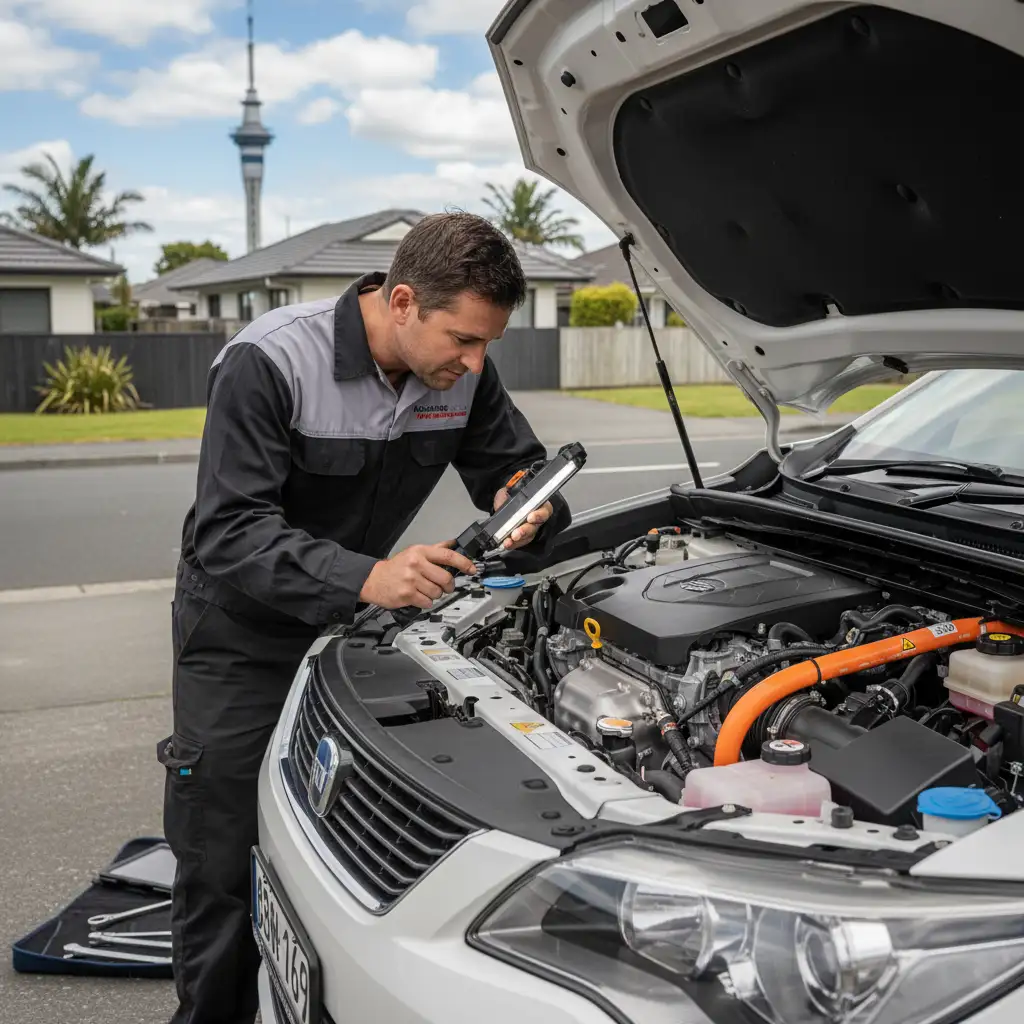
Engine and Battery Integration Challenges
The integration of an electric motor with a petrol engine is a marvel of engineering, but it is also the source of specific wear patterns that require targeted servicing. In the context of Auckland’s variable traffic conditions—from the stop-start gridlock of the Southern Motorway to the open roads of the Waitakere ranges—these systems are put to the test.
The “Cold Start” High-Load Phenomenon
One of the most significant issues PHEVs face is the “cold start” under load. Imagine driving your PHEV in EV mode; the battery depletes while you are merging onto the motorway at 100km/h. Suddenly, the internal combustion engine (ICE) kicks in to provide power. Unlike a normal car that idles to warm up, the PHEV engine is immediately forced to high RPMs to match the vehicle speed and charge the battery. This places immense stress on piston rings and bearings if the oil is not of the highest quality and viscosity.
Oil Dilution and Moisture Buildup
Because PHEV engines often run for short bursts, they frequently fail to reach optimal operating temperatures. This prevents the engine from burning off condensation and unburnt fuel that accumulates in the crankcase. Over time, this leads to oil dilution (fuel mixing with oil) and sludge formation. During our mobile servicing visits across Auckland, we frequently see oil that has degraded faster than the manufacturer’s recommended interval suggests. Therefore, we often recommend shorter oil change intervals for PHEVs compared to their non-hybrid counterparts.
Fuel Stagnation
For diligent PHEV owners who charge daily and rarely use the petrol engine, the fuel in the tank can go stale. Stale petrol loses combustibility and can gum up injectors. A specialized PHEV service includes checking fuel quality and advising on the usage of fuel stabilizers if the combustion engine is rarely utilized.
Critical Hybrid System Checks
Beyond the engine, the high-voltage components require rigorous safety checks and maintenance. Ignoring these can result in expensive repairs or safety hazards.
Inverter and Motor Cooling Systems
Most PHEVs have two separate cooling systems: one for the combustion engine and a dedicated loop for the inverter and electric motor. The inverter converts high-voltage DC from the battery to AC for the motor. This process generates significant heat. If the inverter coolant degrades or leaks, the inverter can overheat and fail—a repair that often costs thousands of dollars. During a service, we test the conductivity and pH levels of the inverter coolant to ensure the system is protected against corrosion and overheating.
High-Voltage Battery Health (SOH)
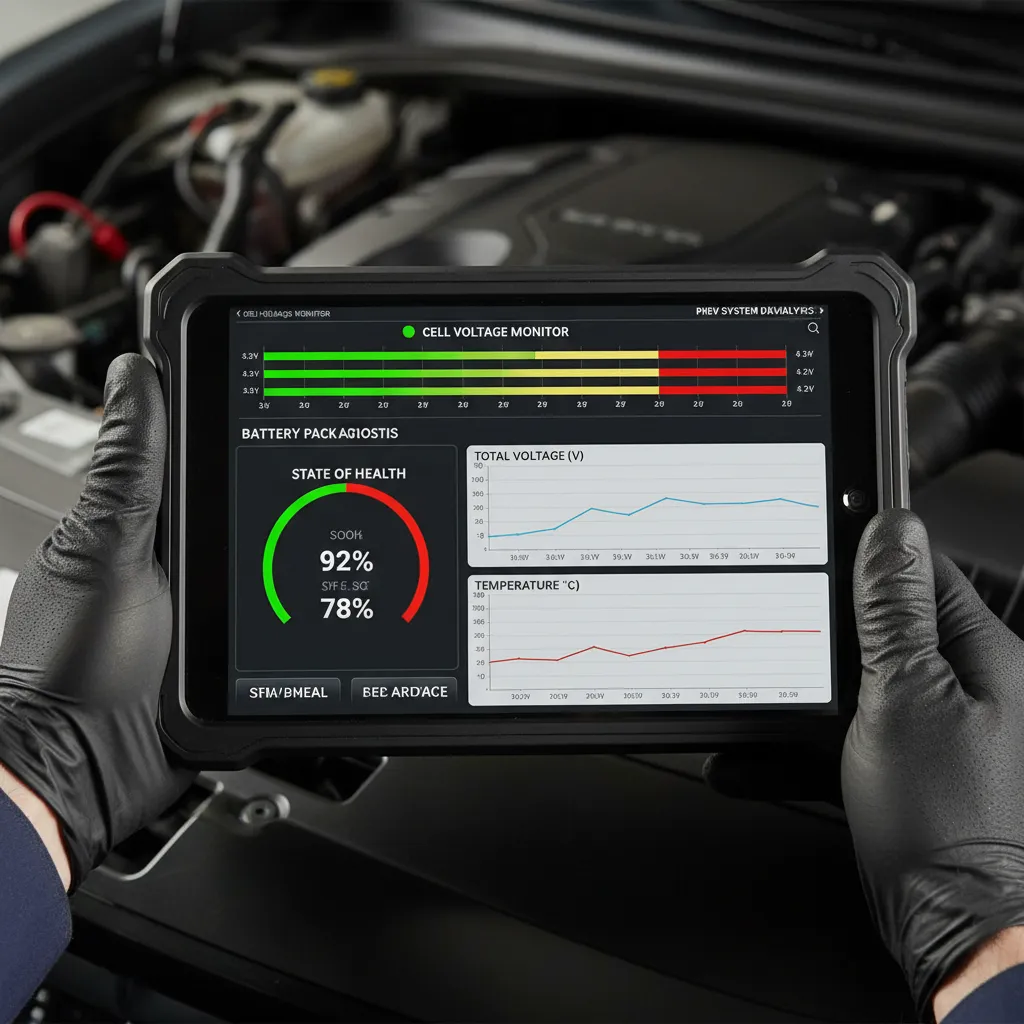
The heart of your PHEV is its high-voltage battery. Over time, lithium-ion cells degrade. A mobile diagnostic service should always include a State of Health (SOH) report. This involves connecting a specialized scan tool to the OBD-II port to read the voltage of individual battery cells. We look for “delta voltage”—the difference between the strongest and weakest cell. A high delta indicates imbalance, which can severely reduce range and trigger warning lights.
High-Voltage Cabling and Insulation
The bright orange cables under your hood carry lethal amounts of electricity. These cables are insulated, but vibration, heat, and rodents can damage this insulation. A visual and physical inspection of these cables is non-negotiable during a service. For more information on electric vehicle safety and high-voltage systems, reliable resources like the U.S. Department of Energy provide in-depth technical data on battery architecture.
Mobile PHEV Diagnostics: Bringing the Shop to You
The traditional workshop model is changing, especially for specialized vehicles like PHEVs. Mobile mechanics in Auckland are increasingly equipped with OEM-level diagnostic tools that allow them to perform dealership-grade servicing at your home or workplace.
Mobile diagnostics for PHEVs rely heavily on software. When a technician arrives at your location, the first step is a global system scan. PHEVs utilize complex Controller Area Networks (CAN bus) where the engine ECU, battery management system (BMS), and transmission control unit communicate constantly. A fault in one can mask a symptom in another.
For example, a “Check Hybrid System” warning might actually be triggered by a minor sensor fault in the combustion engine’s cooling system. Mobile technicians use advanced bi-directional scanners to actuate pumps and fans independently, isolating the issue without needing to disassemble the vehicle. This approach saves time and reduces labor costs for Auckland vehicle owners.
Common PHEV Issues in Auckland Vehicles
Auckland’s specific environment and the popularity of certain imports have highlighted specific trends in PHEV reliability. Being aware of these can help owners catch issues early.
Mitsubishi Outlander PHEV Battery Degradation
The Mitsubishi Outlander PHEV is ubiquitous in New Zealand. Early models (2013-2016) are now showing signs of significant battery degradation. Owners often report a drop in EV range from 40km down to 20km or less. While some degradation is normal, rapid drops can indicate a single failing cell module. Regular SOH checks can help predict this curve.
Toyota Prius Prime Charging Port Locks
Another common issue seen in Auckland is the failure of the charging port locking mechanism on Toyota PHEVs. Due to frequent use and exposure to Auckland’s humid, salty air, the locking pin can seize, either preventing the charger from locking in (stopping the charge) or refusing to release the cable. Lubrication and alignment of this mechanism should be part of your annual service.
Auxiliary (12V) Battery Failure
It is a common misconception that the large high-voltage battery starts the car. In reality, a standard 12V lead-acid battery powers the computer that engages the high-voltage relays. If this small 12V battery dies, the car will not start, even if the main battery is 100% full. Because PHEVs don’t have a traditional alternator constantly charging the 12V system in the same way, these small batteries often fail prematurely. We recommend testing the 12V battery at every service.
The Importance of Brake System Maintenance
PHEVs utilize regenerative braking, where the electric motor acts as a generator to slow the car down and recharge the battery. This means the traditional friction brakes (pads and rotors) are used much less frequently than in standard cars.
While this extends the life of brake pads, it introduces a new problem: seizure. In Auckland’s humid climate, brake calipers that aren’t frequently heated up and exercised can seize on their slide pins. Rust can build up on the rotors because they aren’t being “scrubbed” clean by the pads regularly.
A proper PHEV service involves physically stripping and cleaning the brakes, lubricating the slide pins, and ensuring the pads move freely. This is a crucial step often skipped by quick-lube shops, but it is essential for safety. According to the NZ Transport Agency (Waka Kotahi), brake efficiency is a primary component of the Warrant of Fitness (WoF), and seized calipers are a common failure point for hybrids.
Scheduling Your PHEV Service in Auckland
Maintaining a Plug-in Hybrid requires a shift in mindset. It is not enough to simply change the oil and kick the tires. You are managing a sophisticated piece of technology that integrates high-voltage electronics with mechanical combustion.
By choosing a specialized mobile mechanic in Auckland, you ensure that your vehicle receives the specific attention it needs—from inverter coolant checks to software diagnostics—without the inconvenience of dealership wait times. Whether you drive an Outlander, a Prius Prime, or a European PHEV, regular, specialized maintenance is the key to preserving your battery range and ensuring your vehicle remains reliable for years to come.
People Also Ask
How often should a PHEV be serviced?
PHEVs typically follow the same service intervals as standard cars, usually every 10,000km to 15,000km or every 12 months. However, because the engine runs less frequently, time-based intervals (annual) are often more critical than mileage to check for fluid degradation and brake caliper seizing.
Do PHEVs cost more to service than regular cars?
Generally, the cost is comparable or slightly higher due to the additional checks required. While you save on brake pads and belts, the labor for inspecting high-voltage systems and inverter coolants can balance the cost. However, preventing major electrical failures through regular service saves money long-term.
Can a mobile mechanic service my PHEV in Auckland?
Yes, provided they are qualified in high-voltage systems. Mobile mechanics carry advanced diagnostic tools capable of scanning hybrid battery health and engine systems onsite, offering a convenient alternative to dealership visits.
What happens if I don’t use the gas engine in my PHEV?
If the gas engine isn’t used, fuel can go stale, and moisture can accumulate in the oil. Most modern PHEVs have a maintenance mode that forces the engine to run periodically to circulate fluids and consume old fuel to prevent damage.
How long do PHEV batteries last?
PHEV batteries are designed to last the life of the vehicle, typically 10 to 15 years. However, some capacity loss (degradation) is normal over time. Regular maintenance and avoiding leaving the battery at 0% or 100% charge for long periods can extend its life.
Do I need to change the transmission fluid in a PHEV?
Yes. PHEVs use specialized transaxles containing electric motors. The fluid in these units cools the electric motors and lubricates the gears. It requires changing at manufacturer-specified intervals to prevent electrical shorts and mechanical wear.