
Shock absorber replacement cost NZ typically ranges from $350 to $800 per pair for standard Japanese vehicles, including parts and labour. European or luxury vehicles may cost between $900 and $1,500 per pair due to complex suspension systems. Always replace shocks in pairs to ensure balanced handling and safety.
Understanding Shock Absorber Replacement Cost in NZ
When budgeting for suspension maintenance in New Zealand, understanding the variables that influence the price is essential. The cost is rarely a flat rate because suspension systems vary drastically between vehicle manufacturers. For the average Kiwi motorist driving a Toyota Corolla, Mazda Axela, or Suzuki Swift, prices remain relatively affordable. However, owners of European marques like Audi, BMW, or VW generally face higher bills due to the cost of imported parts and specialized labour requirements.
The total price is composed of three main factors: the hardware (shock absorbers or struts), the auxiliary components (strut mounts and protection kits), and the labour charge. In New Zealand, mechanical labour rates typically fluctuate between $90 and $160 per hour depending on the region and the workshop’s expertise.
Parts vs. Labour Split
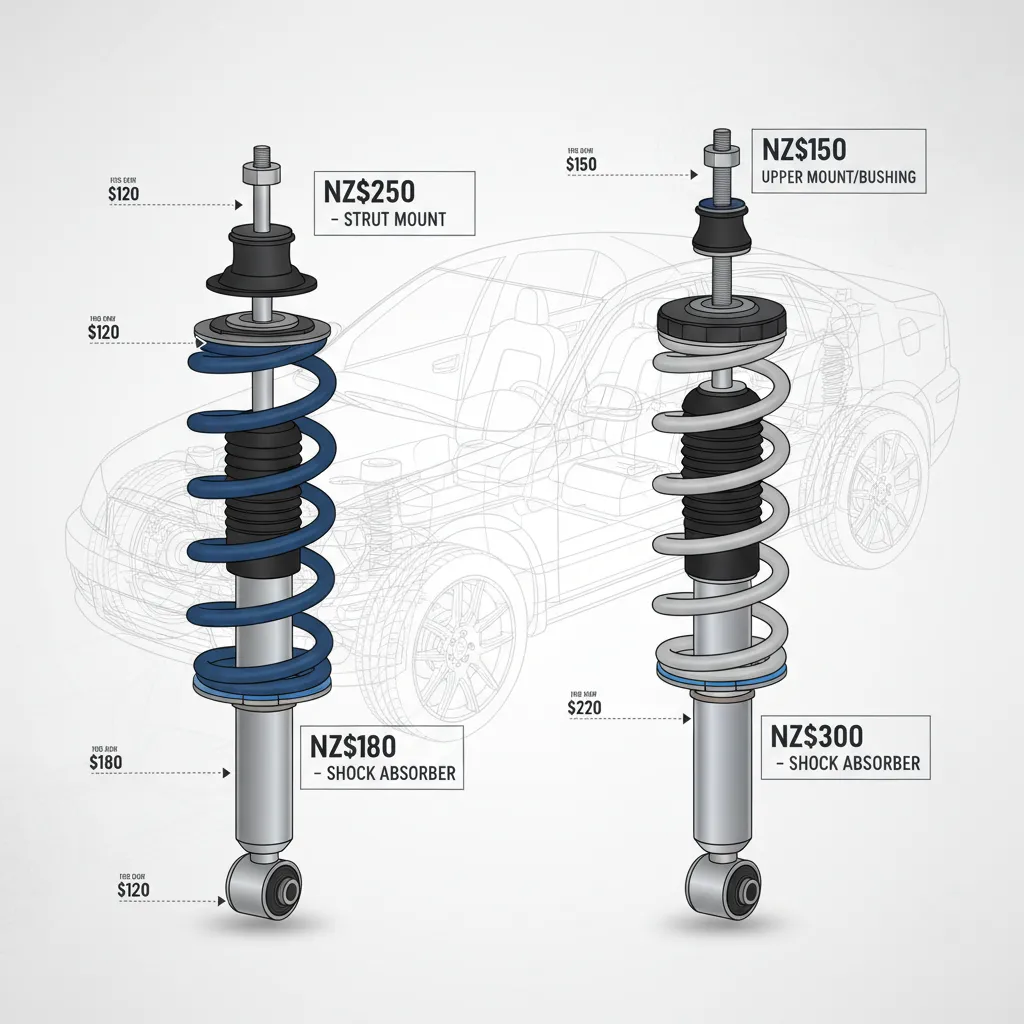
Generally, the cost split is approximately 60% parts and 40% labour. A standard rear shock absorber might cost between $90 and $180 per unit, while a complex front strut assembly can range from $200 to $450 per unit. It is crucial to note that mechanics will almost always recommend replacing shock absorbers in pairs (both fronts or both rears) to maintain vehicle stability. Replacing a single shock can lead to uneven damping, causing the vehicle to pull to one side during braking or cornering.
Additional Component Costs
A common surprise for vehicle owners is the additional cost of strut mounts and protection kits (bump stops and dust boots). When a mechanic disassembles a strut, they often find the rubber mounts are perished or the bearings are seized. Reusing old mounts on new shocks is false economy, as they are likely to fail shortly after, requiring the same labour to be paid twice. A protection kit usually costs $40-$80, while strut mounts can range from $50 to $150 each.
Critical Signs of Worn Shock Absorbers
Shock absorbers are the unsung heroes of your vehicle’s safety system. Unlike a flat tyre or a dead battery, suspension wear happens gradually. This slow degradation means drivers often subconsciously adjust their driving style to compensate for the poor handling, not realizing how dangerous their vehicle has become until an emergency maneuver is required.
Excessive Bouncing and Instability
The primary function of a shock absorber is to dampen the energy stored in the coil spring. Without working shocks, your car is essentially a bobblehead doll. If you drive over a speed bump or a dip in the road and your car continues to bounce more than once or twice, your shocks are likely shot. This “floaty” feeling at highway speeds is a major indicator that the hydraulic fluid or gas within the shock has lost its efficacy.
Nose-Diving and Squatting
Pay attention to the vehicle’s chassis dynamics during braking and acceleration. “Nose-diving” occurs when the front of the car dips excessively when you apply the brakes. This is dangerous because it transfers too much weight to the front tyres too quickly, reducing rear traction and significantly increasing stopping distances. Conversely, “squatting” is when the rear dips during acceleration. Both symptoms indicate that the suspension can no longer control the weight transfer of the vehicle body.
Visual Inspection: Leaks and Physical Damage
While dynamic signs are felt while driving, a visual inspection can provide definitive proof of failure. You don’t always need a hoist to check this; often, you can see enough by turning the steering wheel fully to one side or looking through the wheel spokes.
Identifying Hydraulic Leaks
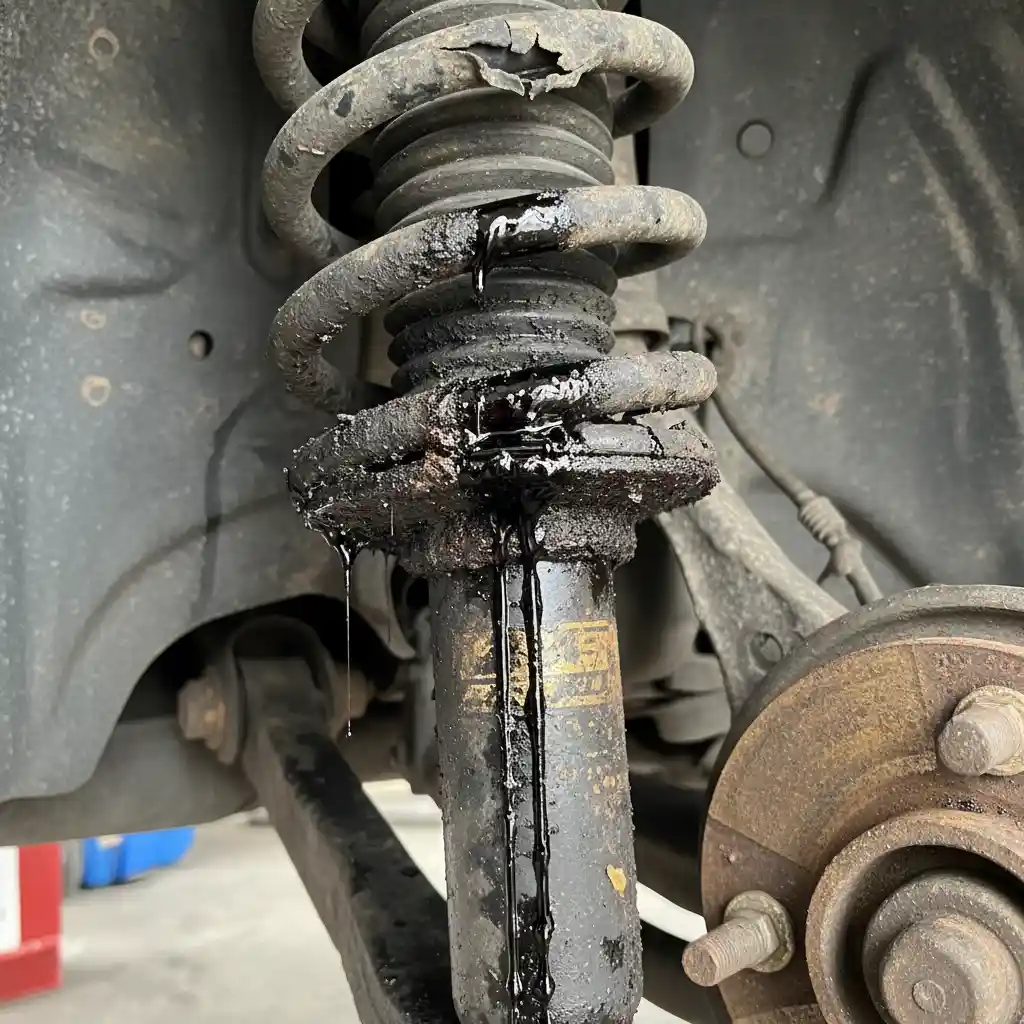
Shock absorbers are filled with hydraulic fluid. When the seals wear out, this fluid begins to weep down the body of the shock. A light “misting” of oil is sometimes considered acceptable by manufacturers, but wet, dripping oil is a clear failure. In the context of a New Zealand Warrant of Fitness (WOF), visible oil leaks on a shock absorber are an automatic fail. The oil attracts road grime, so if you see a caked-on layer of greasy dirt on the shock shaft, it is leaking.
Physical Damage to Bushes and Mounts
Inspect the mounting points where the shock attaches to the chassis and the suspension arm. These points use rubber bushes to isolate vibration. If the rubber is cracked, split, or missing, you will likely hear a clunking or rattling noise when driving over uneven surfaces. Metal-on-metal contact here not only creates noise but can damage the mounting bolts and arms.
Front vs. Rear Replacement: Struts and Shocks
It is important to distinguish between “shock absorbers” and “struts,” as this distinction affects the labour cost significantly. While both dampen oscillation, a strut is a structural part of the suspension system, whereas a shock is generally a standalone link.
Front Suspension (MacPherson Struts)
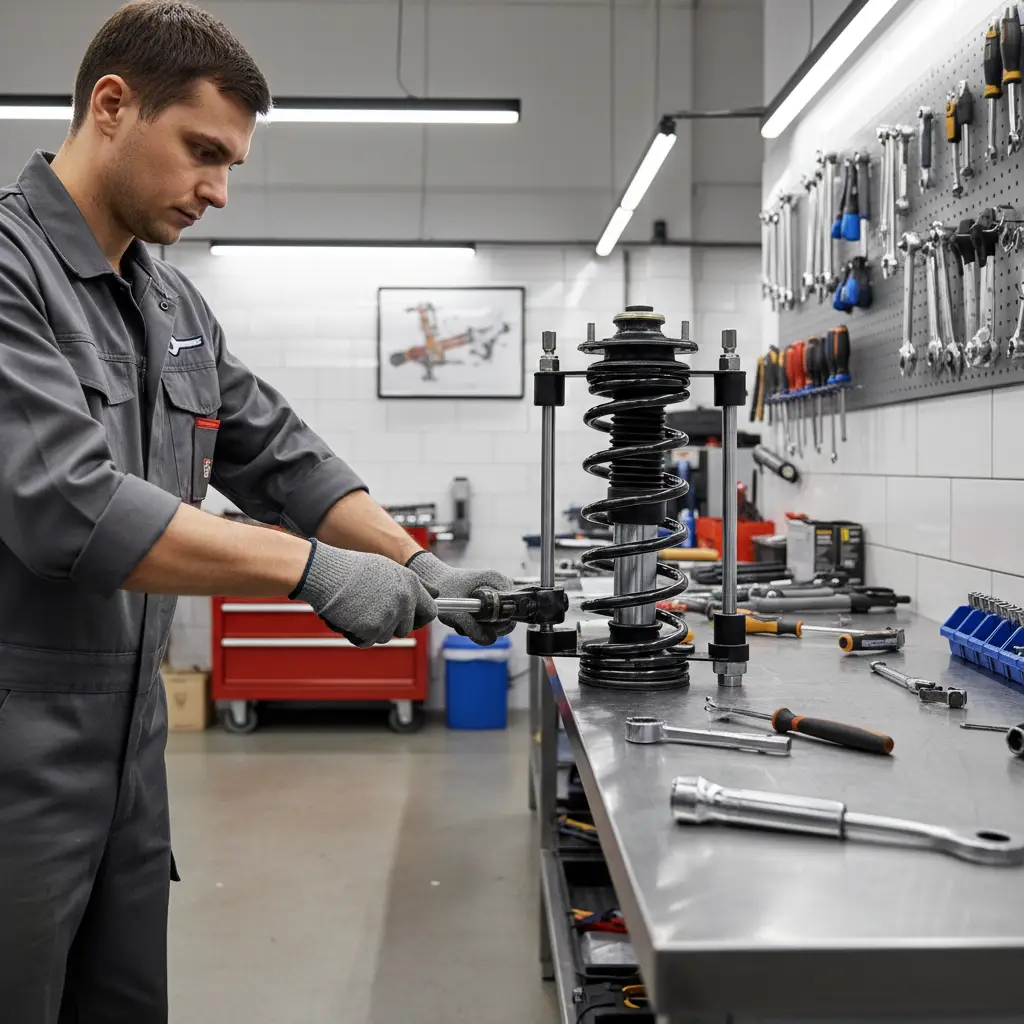
Most modern passenger cars in NZ use MacPherson struts on the front. The strut assembly includes the shock absorber and the coil spring in one unit. Replacing these is more labour-intensive because the mechanic must remove the entire assembly, use a spring compressor to safely remove the high-tension spring, and then transfer the spring to the new strut. This process requires specialized safety equipment and takes more time.
Rear Suspension
Rear suspension setups vary. Many hatchbacks use a torsion beam rear with a simple shock absorber mounted separately from the spring. Replacing these is often much faster and cheaper, sometimes involving just two bolts per side. However, vehicles with independent rear suspension (IRS) may utilize rear struts, which carry similar complexity and costs to front struts.
The Hidden Costs: Tyre Wear and Safety Risks
Delaying shock absorber replacement is a false economy. While you might save money in the short term by deferring the repair, you are actively destroying your tyres. Worn shocks allow the tyre to bounce rapidly on the road surface, a phenomenon known as “wheel hop.”
Cupping and Scalloping
This bouncing creates a specific wear pattern called “cupping” or “scalloping,” where patches of rubber are scrubbed off the tyre tread. Once a tyre is cupped, it becomes incredibly noisy (often sounding like a bad wheel bearing) and offers significantly reduced grip. No amount of wheel alignment will fix a cupped tyre; it must be replaced. Therefore, a $500 shock replacement bill ignored today can easily turn into a $1,200 bill for shocks and new tyres three months later.
Impact on Stopping Distance
Safety is the paramount concern. Research has shown that at 50km/h, a vehicle with one worn shock absorber can have a stopping distance increased by up to 2 meters. At highway speeds, this difference can be fatal. The Anti-lock Braking System (ABS) and Electronic Stability Control (ESC) rely on the tyres being in firm contact with the road. Worn shocks disrupt this contact, confusing the electronic safety systems and reducing their effectiveness.
Warrant of Fitness (WOF) Requirements
In New Zealand, the Warrant of Fitness inspection follows strict guidelines set by the NZ Transport Agency (Waka Kotahi). Suspension is a critical safety item. Inspectors check for corrosion, leaks, insecure mounting, and excessive play.
According to Waka Kotahi NZ Transport Agency, a vehicle will fail its WOF if the damping effect is noticeably weak or if there is significant fluid leakage. If you are taking your car in for a WOF and suspect your shocks are borderline, it is often better to have them assessed beforehand to avoid the hassle of a re-check. A failed WOF due to suspension usually mandates an immediate repair as the vehicle is deemed unsafe.
The Replacement Process Explained
When you book your car in for a shock absorber replacement, the process is systematic. Here is what typically happens in a professional workshop:
- Road Test: The technician drives the vehicle to confirm the symptoms and listen for specific noises.
- Lifting and Removal: The car is placed on a hoist, wheels are removed, and the suspension is unloaded. Penetrating oil is often applied to rusted bolts (common in older NZ cars).
- Disassembly: For struts, the assembly is removed and placed in a spring compressor. The top mount is removed, and the spring is inspected for cracks.
- Installation: The new shock/strut is primed (pumped a few times to distribute fluid). The spring and new mounts are installed.
- Torquing: The assembly is reinstalled into the vehicle. Crucially, the final tightening of the lower mounting bolts should be done with the vehicle’s weight on the wheels (or simulated) to prevent twisting the rubber bushes.
- Wheel Alignment: This is a mandatory step after strut replacement. Since the suspension geometry has been disturbed, a wheel alignment ensures the car drives straight and tyres wear evenly.
Choosing the Right Brand
The NZ market is well-served by reputable aftermarket brands. KYB and Monroe are the market leaders, offering excellent quality that meets or exceeds OEM specifications. For performance vehicles, brands like Bilstein or Koni are popular but carry a premium price tag. Avoid unbranded or “white box” suspension parts found on cheap online marketplaces; the savings are minimal compared to the risk of early failure and poor safety performance.
Frequently Asked Questions
Here are common questions vehicle owners ask regarding suspension maintenance.
How often should shock absorbers be replaced?
Shock absorbers generally last between 80,000km and 100,000km. However, this depends heavily on road conditions. In rural New Zealand, where gravel roads and potholes are common, replacement may be needed sooner, often around the 60,000km mark.
Can I replace just one shock absorber?
No, you should never replace just one shock absorber. They must be replaced in pairs (both front or both rear). Replacing only one creates an imbalance in the suspension, leading to unpredictable handling and dangerous instability during braking.
Do I need a wheel alignment after replacing shocks?
Yes, especially if you are replacing struts. The replacement process involves removing suspension components that determine the angle of your wheels. Without an alignment, your steering may be off-center and your tyres will wear out rapidly.
How long does it take to replace shock absorbers?
Replacing a pair of rear shocks usually takes 1 to 1.5 hours. Replacing a pair of front struts is more involved and typically takes 2 to 3 hours, plus the time required for a wheel alignment.
What is the difference between shocks and struts?
A shock absorber is a standalone part that dampens movement, while a strut is a structural part of the suspension chassis that also holds the coil spring. Struts are more expensive and labour-intensive to replace than simple shock absorbers.
Will new shocks improve ride quality?
Absolutely. New shocks will restore the factory ride quality, reducing road noise, eliminating excessive bouncing, and making the vehicle feel tighter and more responsive to steering inputs.